The more time I spend with early stage startups, the more I see CEOs and their leadership vary a lot on how they think about setting goals. Having spent 30+ quarters doing this, I believe I’ve gotten to an effective framework for early stage startups, where pretty much everything is difficult to predict.
Often, leaders use two numbers when setting targets, a goal that they align with the team on, and a base case that they use for planning. The problem with doing this in early stage startups, is that it’s harder to know what the future will look like than at more mature companies. The resulting behavior is that you end up either consistently missing your goals, which demoralizes the team, or you end up creating conservative goals and encouraging your team to sandbag. Neither is ideal, particularly when you consider that a good achievement score of OKRs is in the 70% range.
What you want is a leadership team that thinks big, executes well, is okay coming short and doesn’t allow you to run out of money/resources.
Based on that, what I think is ideal to establish three numbers when setting goals:
- Your Goal: This is your big, ambitious number. If your’e familiar with OKRs, this is your OKR numbers. This is the number that you shouldn’t consistently hit, but set your team up to think about big achievements. Hitting this number should trigger a party, bonuses, accelerators, whatever. It’s a hard number to hit.
- Your Target: This is the number that you you would consider to be very good execution. It’s the “I’m happy with what we got done” number. You want to pay your team 100% of their variable compensation if they hit this. Most quota carriers are used to OTE – this is the the OTE number. As a CEO, you should feel confident in your strategy and your team if you’re consistently hitting this number. If you’re not hitting your Target in a particular area, this is a place to spend time figuring out why, and how to course correct. This is also the number that you should provide to your Board as your business targets – typically they’re about 80% of your Goal number.
- Your Forecast: This is your base case. This is typically 80% of your Target number. These are the numbers that you should use with Finance, and HR to manage the business. Using your Target or Goal number to drive hiring plans creates a lot of risk. Your VCs will generally encourage you to do this, but you need to understand that unless you’ve consistently hit your target numbers, there’s a good chance that you’ll miss and end up too far in front of your skis. When you’re in the early stage, you typically don’t have a track record of hitting your targets. Don’t forget rule #1 of startups: stay alive.
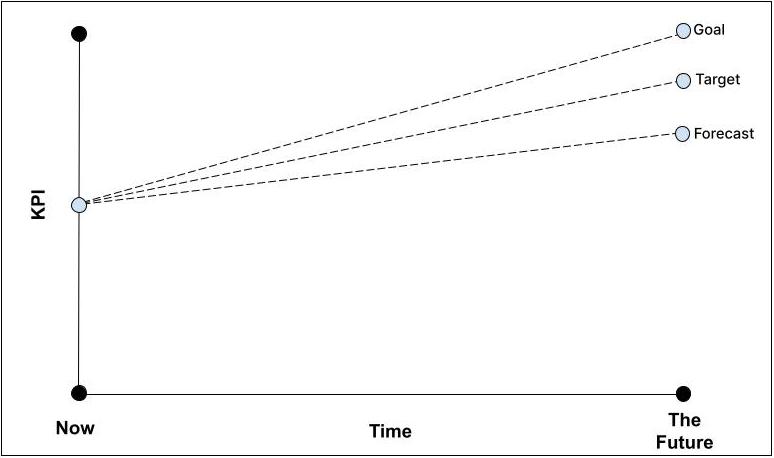
You can set these numbers for any measurable KPI, and for any time interval. As you move from the present, towards the end point (quarter, year, etc), these numbers will start to converge at a point. Ideally, you’re landing at or above target, in which case you can start to raise targets.
Hope this helps someone. Go get em.
 Hi, my name is Christian.
Leave a comment